
6.2 Overview of central SIX equity indices
The most important Swiss indices are explained below for illustrative purposes; the index methodology is governed by the respective index rules. All information on the composition of the SIX Swiss Equity Indices can be found in the so-called Index Rulebook at the following link: SIX
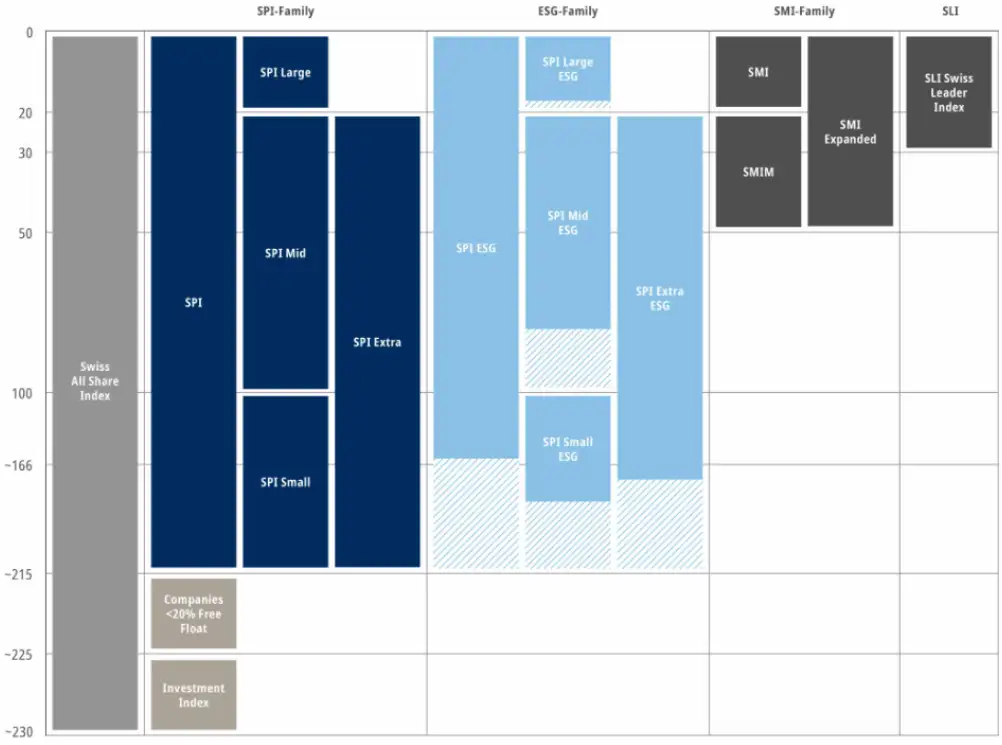
Swiss Market Index (SMI)
The SMI is the best-known and most important equity index in Switzerland. It comprises the 20 largest and most liquid listed companies based in Switzerland. The selection is made on the basis of a selection list that is based on the average free-float market capitalization of the last 12 months. The cumulative order book turnover of the last 12 months is also included in the selection.
The weighting of the securities in the SMI is based on the free-float market capitalization, capped at 18% (price x number of shares x free-float factor x cap factor). This means that a single security may not have more than 18% weight in the index. This cap therefore limits the concentration of very large stocks (this concerned, for examplein the past, inter alia: Nestlé, Novartis or Roche) and enables compliance with regulatory requirements for diversification. The capping of the weightings of the securities is reviewed quarterly and adjusted where necessary and ad hoc if two companies each exceed 20% weight.
The SMI serves as a leading index for the Swiss economy. Many ETFs, structured products and institutional investors are guided by its composition. When a company is included in the SMI, this often leads to increased attention and demand on the stock exchange.
Swiss Performance Index (SPI)
Der SPI bildet den gesamten investierbaren Aktienmarkt der Schweiz ab. Er umfasst sämtliche Unternehmen, die
The SPI tracks the entire investable equity market in Switzerland. It comprises all companies with a primary listing on SIX Swiss Exchange and a free float of at least 20%. The SPI thus forms the basis for most other Swiss equity indices.
The SPI covers large as well as medium-sized and smaller companies. This broad spread gives a realistic picture of the overall situation on the Swiss equity market. Unlike the SMI, there is no upper limit for the number of companies included.
As a rule, a company is included in the SPI from the second trading day following its IPO, provided that it meets the criteria. The performance of the SPI is published as a total return index, which means that dividends are fully reinvested. Return variants such as price return (PR) and net return (NR) are also available.
SPI ESG
The SPI ESG is a sustainability-oriented variant of the SPI. It is based on the same universe, but applies additional ESG criteria (environmental, social, governance). This includes, for example, the exclusion of companies that violate the UN Global Compact and the OECD criteria or generate certain critical sales (e.g. with weapons or fossil fuels).
The ESG rating is based on the so-called “ESG Impact Rating”, which is provided by an independent research provider. Only companies with a rating of at least C+ are included in the SPI ESG. This index is therefore aimed specifically at investors who consider sustainability a key investment criterion.
Swiss Leader Index (SLI)
The SLI is an index of 30 stocks selected both by size and trading volume. It consists of the 20 SMI securities and 10 additional, particularly liquid companies. The difference to the SMI lies in the weighting: in the SLI, the 4 largest stocks are limited to 9% each, the following stocks to a maximum of 4.5%. This makes the index more diversified and less susceptible to the dominance of individual heavyweights.
The SLI is of particular interest for investors seeking a balanced exposure to large and medium-sized Swiss companies. It is also the basis for various derivative financial instruments.
SMI Mid (SMIM)
The SMIM contains the 30 largest mid-cap companies that are included in the SPI but not in the SMI. The SMIM represents the market segment that is located between the large blue chips and the smaller second-tier stocks.
As with the SMI, selection is based on average free-float market capitalization and cumulative order book turnover of the past 12 months. The SMIM is an index with no capping rules.