
4.7 Engaging with Passive Investors: A strategic Imperative for Swiss Issuers
Authors:
- Andreas Posavac, Managing Partner, Embera Partners
- Shanaya Lakhani, Senior Advisor, Embera Partners
Last updated on December 11th, 2025
Purpose
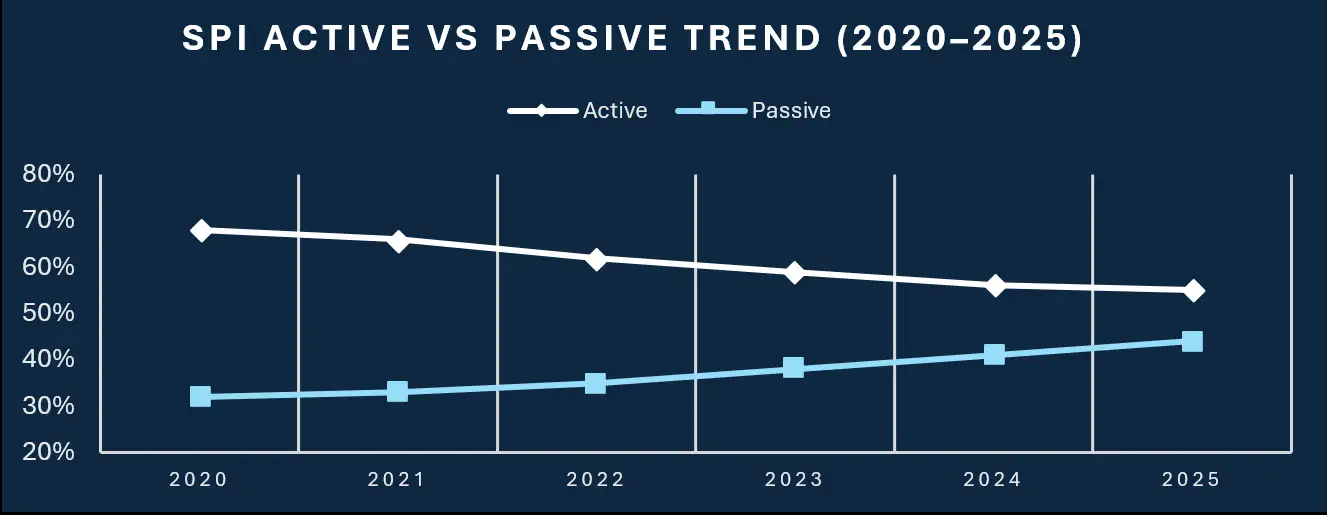
Over the past decade, the ownership base of listed companies has shifted more dramatically than at any time since the rise of institutional investing. Passive strategies—index funds, ETFs, and quantitative portfolios—now control a significant share of equity assets globally and represent a large portion of the shareholder base for most issuers. In the Swiss market alone, passive ownership of the main equity index has risen sharply1 in recent years as capital has migrated from active mandates into benchmark-tracking strategies.
This transition has reshaped the entire dynamic between companies and their investors. Passive funds, both index-trackers and quantitative investors, do not engage in human-driven discretionary stock selection, nor do they participate in traditional investor meetings centred on financial performance or valuation. Yet they are far from silent. Because these investors cannot easily divest from companies included in their index benchmarks, they rely extensively on governance oversight, stewardship dialogue, and proxy voting to manage risk and protect long-term value.
For issuers, this represents both an opportunity and a responsibility. Traditional Investor Relations alone is no longer sufficient to address the expectations of a shareholder base that has become largely IR-immune from a traditional investor engagement perspective2, one that increasingly evaluates companies through the lens of governance quality, board effectiveness, remuneration alignment, and transparent disclosure. Executives and board members must recognise that engagement with passive investors is now a strategic component of maintaining credibility in the capital markets
This article outlines how passive investors assess issuers, why their influence has grown, and how boards and executive teams can respond effectively.
Understanding Passive Investors: Long-term Owners with structured Expectations
Passive investors are often misunderstood as their portfolio construction is rules-based and benchmark-driven, and they are sometimes perceived as universal owners who are disengaged or indifferent. In reality, passive investors tend to be among the most active stewards in the governance ecosystem, as they have a fiduciary duty for their beneficial owners, many being pension and insurance funds.
As permanent and influential shareholder group, passive funds hold positions as long as issuers remain in the index they track. This creates a form of permanent capital that does not fluctuate based on short-term market sentiment. Quantitative investors are model driven and usually trade on the basis of market signals, momentum and fundamental KPI’s, most recently also including extra-financial, sometimes unstructured data points.
For issuers, this means these investors remain on the share register across cycles, vote consistently at AGMs, and they expect predictable, transparent governance communication.
Their influence is amplified by high voting participation rates—often above 80–90%—and strong alignment with global proxy advisors on key topics such as remuneration, board independence, and sustainability oversight.
Governance is their main channel of influence since passive investors often cannot exit based on concerns around strategy or performance, governance becomes their primary means of evaluating whether risks are being managed effectively. Their expectations are informed by publicly disclosed stewardship principles, voting guidelines, and global thematic priorities.
Financial performance matters, but governance quality is what gives passive investors confidence that long-term risks and opportunities are being appropriately overseen.
How Passive Investors form Judgements about Issuers
Passive investors evaluate companies through a structured and policy-driven lens. Their assessments tend to cluster around several core themes that consistently appear in engagement discussions and AGM voting patterns involving:
Board composition and effectiveness: The board remains one of the most closely examined elements of an issuer’s governance framework. Passive investors look not only at independence, skills3 and tenure but at whether committees are appropriately structured, whether succession planning is credible, and whether directors collectively possess the skills required to oversee strategy and emerging risks. Diversity, particularly gender representation, has evolved into an indicator of governance quality rather than a symbolic objective, and transparent skills matrices are now widely expected. Recent voting outcomes demonstrate a growing reluctance to support long-tenured directors and a preference for boards that demonstrate refreshment, capability, and clear oversight processes.
Executive remuneration: Remuneration continues to shape many stewardship judgements. Passive investors focus on whether performance metrics are well defined, whether variable pay outcomes correspond to company performance, and whether remuneration committees exercise discretion responsibly and transparently. Dissent rarely reflects views on the absolute quantum of pay. Instead, voting opposition typically arises when disclosures fail to articulate how incentives work, when performance targets appear insufficiently demanding, or when realised pay does not align with shareholder outcomes. Issuers that explain their remuneration philosophy in a clear, data-driven manner generally receive stronger support.
Sustainability and risk oversight: Sustainability has become a core governance concern because it is intertwined with long-term strategic and operational risk. Passive investors assess how boards oversee climate transition plans, broader sustainability risks, and the reliability of related reporting. The increasing number of binding votes on sustainability reports has raised expectations for defined climate targets, credible transition pathways, and evidence that sustainability considerations are embedded into governance processes. Over time, greater external assurance of non-financial data is likely to form part of investor expectations.
- Shareholder rights and governance structures: Passive investors also evaluate the broader governance environment in which the board operates. Strong shareholder rights, transparent capital authorisations, robust oversight of related-party transactions, and annual director elections are all viewed as indicators of accountability. These governance foundations form a baseline against which issuers are assessed and often influence voting outcomes across multiple agenda items.
Why Passive Investors require a new Engagement Model
Passive institutions do not engage to debate valuation, short-term performance, or market positioning. Their stewardship teams focus instead on whether an issuer’s governance framework is sufficiently robust to protect long-term shareholder value. As a result, the nature of dialogue shifts from financial persuasion to a structured examination of governance quality, board oversight, and risk management, certainly linked to a company’s strategy. Passive investors are also driven by their beneficial owner requirements, often asked to demonstrate active portfolio-company engagement, with a specific focus on improving the overall governance risks, focusing on outliers, companies with high dissent and governance weaknesses as well as companies where impact is most likely high.
Their engagements are policy-driven and evidence-based, requiring issuers to demonstrate clarity of governance decision-making and the rationale behind board actions. Since these discussions frequently involve topics that sit squarely within the remit of board committees, passive investors often prefer that independent directors participate directly but investor relations teams are welcomed to steer the conversation and serve as the essential conduit to not only organize but frame the conversation. Board-level involvement signals accountability and reinforces that the issuer’s governance practices are carefully considered at the highest levels, with investor relations being the connector to management and certainly in a position to support external and internal communications of expectations, feedback and requirements.
Preparing internally for effective Passive Engagement
Effective engagement with passive investors requires a high degree of internal coordination. Although the themes differ from traditional IR meetings, the level of preparation expected is just as rigorous—and often more so. Several elements form the backbone of successful preparation:
Understand the Shareholder Base
Preparation begins with a clear understanding of the shareholder register and corresponding beneficial owners. Mapping passive and quantitative investors, analysing historical voting behaviour, and identifying themes that have driven dissent in previous years allow issuers to anticipate concerns before they arise. This foundation gives boards and executives the ability to address governance questions with specificity, signalling the attentiveness and seriousness that stewardship teams increasingly expect. For example, free-float dissent rates above 20% of outstanding capital are considered high and often put companies on the “red-flag”-list for large shareholders to start an engagement process hence being on the front foot, knowing exactly the investor profile on a fund-by-fund level, is key.Strengthen Public Disclosure
High-quality disclosure is a cornerstone of effective engagement. Because passive investors rely almost entirely on public information, governance and sustainability disclosures must be clear, consistent, and forward-looking. Issuers that explain their board composition, skills mix, succession planning, remuneration philosophy, and sustainability oversight in a coherent and integrated way reduce ambiguity and voting risk. Transparent disclosure is not simply a compliance requirement—it is a signal of governance competence and a key determinant of investor confidence.Prepare the Board for Direct Dialogue
Boards must be equipped to participate meaningfully in stewardship conversations. Committee chairs and independent directors should be briefed on investor expectations, global voting policies, and the relevant governance trends shaping market practice. Well-prepared directors are able to articulate the rationale behind board decisions with clarity and credibility, ensuring that conversations with stewardship teams are aligned, confident, and reflective of the issuer’s governance maturity.Integrate Sustainability into Governance Communication
Sustainability considerations now form a core component of governance discussions. Boards are expected to explain how climate risks and other extra-financial factors influence strategy, risk management, and remuneration outcomes. Passive investors increasingly view sustainability not as a separate topic but as evidence of the board’s broader oversight capabilities. Issuers who can demonstrate this integration effectively are better positioned to build trust and avoid recurring dissent.
Practical Recommendations for engaging with Passive Investors
As passive ownership continues to expand, issuers benefit from a clear set of practical steps that guide how to prepare for stewardship dialogue. The following summary provides a concise framework that boards and executive teams can use when planning engagement with passive investors:
Who Should Engage
Board Representatives – ideally the Chair or Lead Independent Director
Engagement carries the most weight when led by the board. Passive investors view governance as a board responsibility, and discuss topics such as remuneration, succession planning, and risk oversight more effectively with committee chairs or the Chair of the Board or the lead independent director. Their involvement demonstrates accountability and reinforces that governance matters are treated strategically, not administratively.Head of Investor Relations or team – as the coordinator and continuity anchor
IR plays a central role in shaping the narrative, preparing materials, understanding investor policies, and maintaining year-round communication. While governance discussions are board-led, IR ensures that messaging is consistent and that insights from engagement feed back into internal decision-making.Executive management – as needed, depending on the topic
Management may participate when the discussion touches on operational execution, sustainability strategy, or risk frameworks that require management context. However, governance topics should remain board-led to align with investor expectations.
When to Engage
Outside peak proxy season — ideally Q4 or early Q1
Passive investors consistently emphasise that the most productive conversations occur before voting season. Engaging early allows investors to consider evolving governance practices, upcoming remuneration decisions, and board changes without time pressure.Ahead of major governance decisions
If the issuer anticipates material changes — such as revising remuneration structures, updating climate targets, or adjusting board composition — early dialogue helps build understanding and avoid surprises at the AGM.Consistently throughout the year
Regular updates, even brief ones, reinforce transparency and build trust over time. Annual governance discussions, supported by brief touchpoints outside the AGM cycle, create continuity and help maintain a transparent, year-round narrative. This sustained rhythm of communication demonstrates seriousness, responsiveness, and long-term orientation; qualities valued by passive investors who remain on the register regardless of market conditions.
What to Discuss
Overall, issuers should prepare a clear agenda on what items the company wants to discuss. This should be led by strategic update and a focus on corporate governance-related updates and adjustments, ideally calibrated with the previous shareholder dissent (check on how your investor counterparts have voted in the last 1-2 AGMs) as well as updated governance policies to which the corporate topics can be aligned with.
Board oversight and governance processes
Investors want clarity on how the board supervises strategy, risk, succession planning, and sustainability. These topics form the core of most passive-investor engagements.Remuneration philosophy and performance alignment
Discussions should explain the rationale behind the remuneration framework, how performance targets are set, and how outcomes align with long-term value creation.Sustainability governance and risk integration
Investors increasingly expect detail on how climate and sustainability considerations are embedded into strategic decision-making, risk frameworks, and board reporting.Past voting outcomes and subsequent enhancements
A transparent explanation of how investor feedback has informed board decisions helps establish credibility and reduces the likelihood of repeated dissent.
How to Prepare
Review stewardship and voting policies before engaging
Most passive investors publish their expectations in detail. These documents offer detailed insight into how institutions evaluate board composition, remuneration outcomes, sustainability reporting, and shareholder rights. Understanding these policies before an engagement allows issuers to tailor their explanations to the investor’s specific priorities and anticipate areas of concern. The most effective issuers incorporate this policy review into their annual governance calendar so that stewardship dialogue is not only reactive but strategically informed.Equip directors with concise briefing packs
Materials should summarise investor priorities, relevant governance trends, and the issuer’s rationale on key decisions. Well-prepared directors communicate more effectively and with greater confidence.Ensure disclosures are clear, consistent, and forward-looking
Passive investors rely heavily on public information. High-quality disclosures strengthen trust, minimise ambiguity, and form the foundation of productive dialogue.
Engagement with passive investors is no longer a procedural exercise — it is a strategic board responsibility. By understanding who should lead discussions, when to engage, what topics matter most, and how to prepare, issuers can build stronger relationships with long-term shareholders and enhance their standing in the evolving governance landscape.
Conclusion: Passive Engagement as a Strategic Board Priority
The rise of passive ownership has reshaped the expectations placed on boards, executives, and investor relations teams.
For boards and executive teams, the implication is clear: effective engagement with passive investors is now a hallmark of modern governance. Issuers that embrace this reality—by preparing carefully, communicating proactively, and involving the board directly—strengthen their credibility and improve their standing with a shareholder base that is structurally embedded in the capital markets. Those who continue to treat passive engagement as an afterthought risk unnecessary dissent, eroded trust, and diminished influence over the narrative that shapes long-term investor confidence. Also, governance signals are being picked up by capital markets stakeholders and the data-ecosystem, often translated into the governance sentiment and often research process, hence a proactive strategy is recommended.
In an environment defined by permanence of capital and increasing accountability, the ability to articulate governance quality—and to demonstrate it consistently—has become a strategic imperative. Engaging thoughtfully with passive investors is therefore not only good practice; it is essential to delivering long-term value for all shareholders.
1 From 32% in 2020 to 45% in 2025, when assessing institutional ownership in SPI.
2 Roadshows and conference participations to pitch a company’s equity story
3 Embera Partners also conducted a market study on Board Skills and importance for capital markets stakeholders