6.2 Reporting Scenarios Based on Geographical Scope
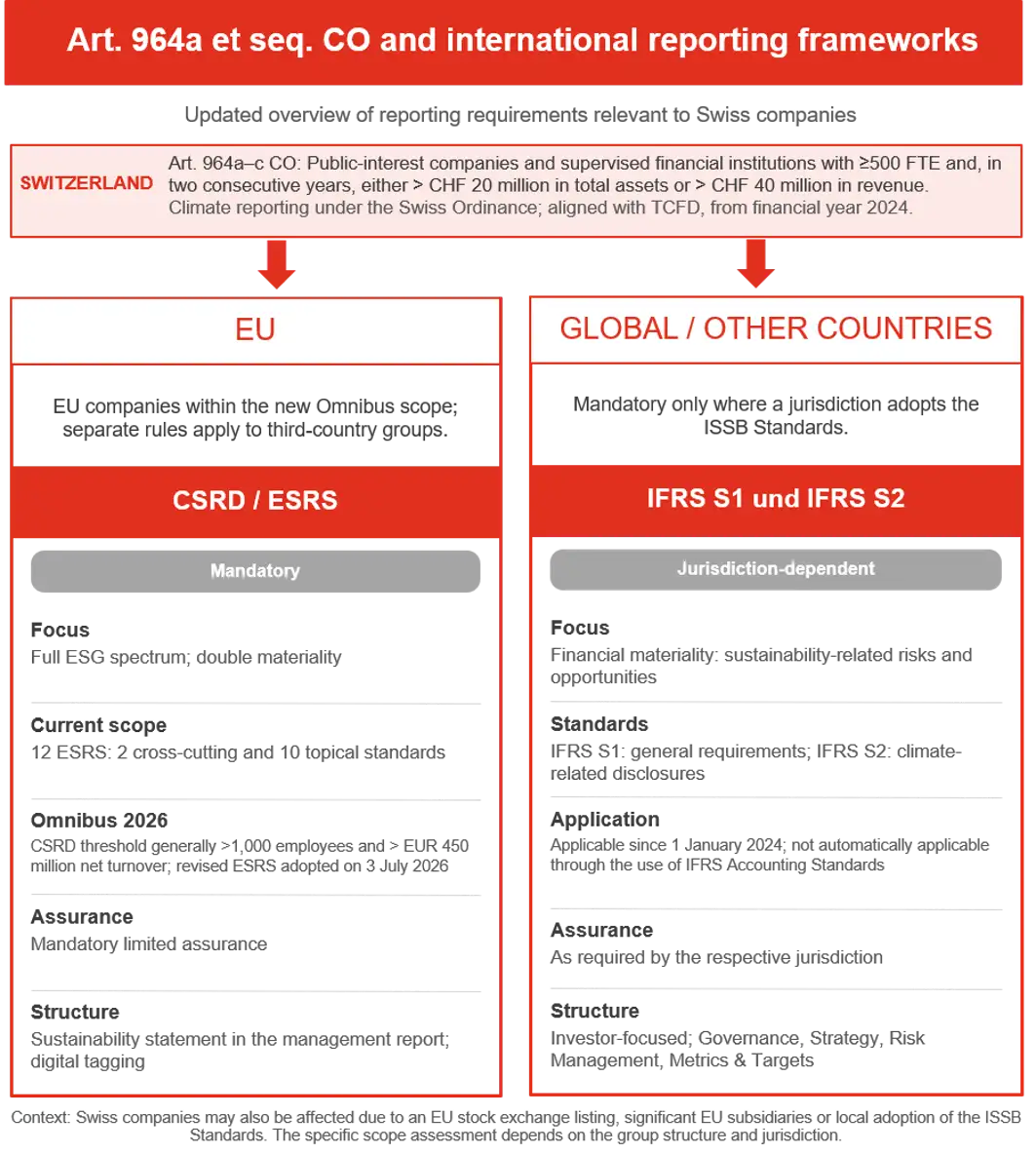
SIX-listed companies are subject to different reporting obligations depending on where the company is headquartered, where it operates and whether it is also listed on another stock exchange. The following four scenarios are possible:
SIX-listed companies operating in Switzerland: Many Swiss SIX-listed companies fall within the reporting obligations under Articles 964a-c CO and the Swiss climate reporting requirements due to their size. Companies that do not fall within the scope of Articles 964a-c CO must nevertheless be prepared to respond to requests for non-financial information from other stakeholders in their supply chains, such as customers, or from financial institutions, such as insurers or banks. It is therefore in these companies’ own interest to report on material non-financial matters identified through their stakeholder materiality assessment.
SIX-listed companies operating in the EU: Depending on their group structure, subsidiaries and the applicable CSRD thresholds, SIX-listed companies operating in the EU may be required to comply with the CSRD and prepare their sustainability reporting in accordance with the European Sustainability Reporting Standards (ESRS). The scope was revised under the Omnibus package and narrowed for certain companies.
SIX-listed companies operating in other countries: The International Sustainability Standards Board (ISSB) published IFRS S1 and IFRS S2 in June 2023 for general sustainability-related and climate-related reporting. The standards build on the TCFD recommendations and focus on sustainability-related risks and opportunities that are financially material to investors.
The applicability of IFRS S1 and IFRS S2 depends on the relevant jurisdiction, as the standards become legally binding only through national or regional adoption. On 25 February 2026, the United Kingdom published the UK Sustainability Reporting Standards (UK SRS S1 and UK SRS S2), which are based on the ISSB standards IFRS S1 and IFRS S2. The standards are currently available for voluntary application. The UK Government and the Financial Conduct Authority are currently considering whether mandatory application should be introduced in the future and, if so, for which companies. In addition, TCFD-aligned reporting is already mandatory for listed companies, banks and insurers with more than 500 employees.
Regulatory requirements for sustainability reporting continue to evolve dynamically. While the European Union has established a comprehensive reporting framework through the CSRD and ESRS and has simplified and adjusted it under the Omnibus initiative, many other jurisdictions are aligning with the ISSB standards IFRS S1 and IFRS S2 or incorporating them directly into national law. Swiss companies should therefore continuously monitor the impact of foreign reporting requirements and align their reporting with the relevant regulatory framework.